
Is your creative business (model) still working for you?
Managing a creative business feels very different right now from how it did five or ten years ago. Many makers, designers, artists and creative freelancers are finding that the routes to market they have relied on for years simply aren't delivering in quite the same way anymore. Etsy and social media have become harder places to get seen and generate consistent sales; craft fairs and design events have multiplied while visitor numbers and spending haven't necessarily kept pace; galleries and independent retailers are facing their own considerable pressures; and selling internationally, particularly into the EU and USA, has become more complicated and expensive.
At the same time, the costs of running a creative business have increased. Materials, energy, postage, event fees, travel, accommodation and packaging all add up, while customers themselves are making more careful decisions about what they spend their money on. For many creative businesses, particularly those selling products in the middle of the market, the sums simply aren't working in quite the same way they once did.
If you are finding things harder at the moment, it is very easy to assume that you are doing something wrong. Perhaps you need to post more often on Instagram, find a better craft fair, improve your website, launch another collection, send more newsletters or finally get your head around SEO.
Some of those things might help. But there is also a much bigger question worth asking:
Is the business model you have built still the right business model for you, your customers and the market you are operating in now?
That is a much more fundamental question than How can I sell more? and increasingly it is a question I am asking the creative business owners I work with.
Because maybe the problem isn't your marketing. Mayb you need to look at the foundations.
And although questioning those foundations can feel uncomfortable, I actually think this is one of the most useful and empowering things you can do in your business. Markets change. Customers change. Technology changes. Opportunities change. And you change too.
A resilient business isn't one that finds a successful formula and then repeats it forever. It is one that notices what is changing, understands its numbers, knows what it stands for and makes deliberate choices about what to keep, what to strengthen and what might need to change.
So in this in-depth article I want to help you stand back and look at your creative business model properly. Not because everything needs to change, and certainly not because I think everybody should suddenly stop selling products and start teaching online courses! Quite the opposite. This is about understanding the options available to you, looking at the facts of your business, and then designing a business model that works better for where you want to go next.
At the end, I will also give you a practical Creative Business Model Audit to help you start asking some of these bigger questions for yourself.
First of all, what actually is a business model?
"Business model" can sound rather corporate and complicated, but it really isn't.
Your business model is essentially how your business works and makes money.
It includes: what you sell, who buys it, how they buy it, what they pay, how frequently they buy, how you reach them, what it costs you to create and deliver what you sell, and ultimately whether enough money remains to create the income and profit you need.
For a creative business, that might mean selling your own work directly through your website and at events. You might also sell through galleries or independent retailers. Perhaps you take commissions, teach workshops, licence your designs, undertake freelance projects, work with interior designers or architects, run retreats, sell digital resources or work with organisations.
Most creative businesses I know don't have just one income stream. They have several, and often those different parts of the business have developed gradually over many years.
You might have started by selling jewellery at local craft fairs, then opened an Etsy shop, started selling through galleries, built your own website, added a Christmas open studio, began taking commissions and, after being asked several times, started teaching workshops too.
Seven or ten years later, you have grown a big & complicated business!
But is this the business you would deliberately design if you were starting again today?
That is where it gets interesting …
Your business model is more than a list of income streams
When you start reviewing your business model, don't simply ask, Which bit makes me the most money?
You need to understand what job each part of your business is doing.
For example, a ceramicist might discover that teaching generates a reliable £15,000 each year. It isn't necessarily the part of her practice she ultimately wants to be known for, but those workshops create predictable cash flow and enable her to spend more time developing ambitious sculptural work that takes much longer to sell.
A jeweller might find that wholesale margins are considerably lower than her direct sales margins, but her best ten stockists order consistently, pay on time and introduce her work to exactly the customers she wants to reach. The answer therefore isn't necessarily stop wholesale. It might be to stop supplying the twenty marginal stockists and develop stronger relationships with the ten that really work.
Or an artist might spend £1,500 exhibiting at a particular event and make only £2,000 in sales. On paper, that doesn't look especially attractive. But if the event consistently leads to commissions, gallery conversations, press coverage and new collectors who buy six months later, it might still deserve its place in the business.
This is why there isn't a universal answer to questions such as:
Should I still do craft fairs? Should I sell wholesale? Should I leave Etsy? Should I teach? Should I take commissions?
The much more useful question is:
Does this work for YOU?
And to answer that properly you need both the options and the evidence. You need to understand the different routes your business could take, but you also need to know your own numbers, customers, capacity, ambitions and values so that you can make deliberate choices rather than simply following whatever happens to be the latest creative-business trend.

The creative marketplace has changed
This is one of the reasons I think we need to have much more open conversations about business models right now.
Many creative product businesses were built around a combination of direct product sales, events, galleries or wholesale and, increasingly over the last decade, online sales and social media.
Some of those routes still work extremely well. But the environment around them has changed considerably.
There are now many more markets, craft fairs and selling events competing for exhibitors and visitors. Event fees, travel and accommodation have increased, and even a successful three-day event can represent a week or more of work once you include making stock, packing, travelling, setting up, selling, returning home and following up afterwards.
Independent shops and galleries are dealing with increased costs and cautious customers too, which inevitably affects the makers who supply them. Meanwhile, selling online isn't the relatively straightforward opportunity it once appeared to be. Etsy is crowded, organic social-media reach is unpredictable, advertising is increasingly expensive, and international sales can involve more paperwork, taxes, duties and customer-service complications than many small creative businesses have the appetite or capacity to deal with.
None of this means that events are finished, wholesale doesn't work or nobody can sell on Etsy anymore.
That kind of sweeping statement isn't useful.
A maker with highly giftable products at £35–£80, efficient production and a well-established group of stockists might have an excellent wholesale business. A jeweller whose customers want to try pieces on and talk to the maker might find that four carefully chosen events generate the majority of her annual income. Somebody with a very distinctive niche and an international customer base might still do exceptionally well on Etsy.
But another maker might realise that after materials, commission, packaging and their own labour are included, wholesale is barely profitable. Somebody else might be producing thousands of pounds worth of stock for twelve events a year while increasingly wanting to create larger, slower and more ambitious work.
The question isn't What works today?
It is: What works for my particular creative business in the market we are operating in now?
That distinction matters enormously.

And … You aren't the same person who started your business either!
It isn't only the marketplace that changes. We do too.
The business model that worked brilliantly for you seven years ago may have been designed, consciously or otherwise, around the person you were seven years ago.
I recently spoke to a creative whose child is now seven and becoming much more independent. For the first time in years, she can see that she is going to have more uninterrupted time available for her business. That opens possibilities that simply weren't realistic when her child was a toddler.
At the other end of the spectrum, somebody in their mid-fifties might finally have children who have left for university and expect to have more freedom, while simultaneously finding that elderly parents increasingly need their time and attention.
Our bodies and (mental) health change too. Packing a van, driving for five hours, setting up a stand and spending four days on your feet might have felt entirely manageable at 35 and considerably less attractive at 55.
I don’t know about you, but our creative ambitions change also when you get older. You might have started by making relatively affordable functional ceramics and now find yourself increasingly drawn towards bolder and more colourful sculptural work. Perhaps you have become more skilled and confident and want to take on much larger commissions. Maybe you started teaching reluctantly because somebody asked you to run a workshop and have discovered, to your surprise, that teaching is both financially rewarding and something you genuinely love.
And our values can change when we get older too (or are we just getting more outspoken about them?!).
Many creatives I work with are much more conscious now of environmental impact and consumption. Producing hundreds of lower-priced products simply to keep feeding the selling machine may no longer sit comfortably with them. They might want to make fewer, more considered pieces, work increasingly to commission, use materials differently, repair or reuse, or develop experiences and teaching alongside their making.
None of these shifts means the old business was wrong.
It did its job.
But what you need your business to do now may be different.
Don't mistake persistence for strategy
Creative people can be remarkably stubborn!
Sometimes that's a fantastic quality. You need resilience and persistence to develop your work, build relationships and establish a creative business over many years.
But persistence can also keep us doing things long after they have stopped making sense.
I've always done this fair.
I've supplied this gallery for twelve years.
I always launch a Christmas collection.
This is what my customers know me for.
Wholesale has always been an important part of my business.
There is comfort in familiarity, particularly when the alternative isn't yet clear. Stopping something can also feel like admitting defeat.
But doing something for a long time isn't evidence that you should continue doing it.
Equally, one disappointing year isn't necessarily evidence that you should stop.
This is where deliberate decision-making matters:
If a craft fair has been disappointing, look at three or four years of figures rather than making an emotional decision on Sunday evening while you're exhausted and packing the car. Look at the actual sales, costs, time involved, new customers acquired, follow-up orders and other opportunities that resulted from being there.
If wholesale has become less profitable, investigate why. Have your material costs increased while your prices haven't? Are your minimum orders too low? Are you spending too much time producing small orders for too many shops? Would ten excellent stockists be more valuable than thirty mediocre ones?
Sometimes the strategic decision is to stop. But sometimes it's to change HOW you do it.
Don't respond to a difficult market by simply adding more
There is another trap I see increasingly.
Product sales become harder, so you decide to teach. Then somebody suggests creating an online course. Commissions look promising, so you add those too. You hear that Substack is growing, so perhaps you need one of those. Someone else tells you licensing is a great source of passive income.
Before long, a business that was difficult to manage with three income streams has seven income streams!
And every additional income stream requires something from you. It needs customers, marketing, pricing, systems, administration and often entirely different skills. The people buying a £40 product might not be the people commissioning a £4,000 piece, and neither may be the audience interested in your £150 workshop.
Diversification can create resilience, but complexity can create fragility.
Redesigning your business model therefore isn't necessarily about adding more. Very often it is about doing less, but doing it better.
Perhaps twelve events become four excellent ones.
Perhaps thirty wholesale accounts become ten stronger relationships.
Perhaps you stop producing three lower-priced collections every year and introduce a smaller permanent collection alongside more profitable commissions.
Perhaps teaching moves from being something you squeeze in occasionally to becoming a deliberate 30% of your annual income, giving you greater financial predictability and allowing you to take more creative risks elsewhere.
The aim isn't to follow the latest trend.
The aim is to design the right combination for you.
Yes, your business needs to make money
I want to be very clear about this because creative businesses sometimes shy away from talking openly about profit.
A sustainable business needs to make money.
You need to pay yourself professionally. You need to cover your overheads. You need money to invest in equipment, photography, materials, exhibitions, professional development and new ideas. You need reserves for the months when sales are quieter or something unexpected happens.
Profit isn't something to be embarrassed about. It is part of what makes your creative practice sustainable.
So when you review your business model, your numbers matter enormously.
Don't rely on the feeling that an event "went quite well". Work out what you actually made after the stand fee, travel, accommodation, materials, card fees and your time.
Don't assume a £20,000 wholesale account is automatically more valuable than £12,000 of direct sales.
Don't dismiss teaching as a sideline if it generates £800 profit in a day and brings you into contact with people who subsequently buy your work.
Know what each part of your business turns over, what it costs and what remains.
But money isn't the only measure.
For many creatives, the business also needs to support their creative ambitions, values, relationships, reputation and the way they want to spend their working life.
A useful way to assess each part of your business is therefore to look at four things (If you have used our Dream Plan Do Business Planner Handbook in the last few years you will recognise this exercise as the 5 Motivations of Creatives!) :
Money: What does this genuinely contribute to turnover and profit? Is it easy & predictable money? Is it ‘good’ money in the quieter months?
Time & capacity: How much does it really require when you include preparation, production, marketing, travel, admin and follow-up?
Strategic value: Does it build reputation, develop relationships, reach the right customers, create future opportunities or move you towards the work you want to be doing?
Creative & personal fit: Does this work align with your values, interests and ambitions, and does it fit realistically with the life you have now?
This is where the answers become much more nuanced.
A major exhibition might not make a profit at all but could be strategically important because it develops a new body of work and puts you in front of curators and collectors.
A regular workshop programme might not be where you want your creative reputation to sit, but it might generate the reliable income that allows you to spend one day every week developing your own practice.
Or a profitable product line might still be something you decide to phase out because it takes up so much production time that it prevents you from developing the commissions you increasingly want to pursue.
Good strategy isn't always about choosing the option that makes the most money today. It is about understanding the consequences of your choices.
So what do you want your business model to do for you?
This is ultimately the bigger question!
Before deciding whether to stop wholesale, teach more workshops, leave Etsy or reduce your events, stand back further.
What kind of creative business are you actually trying to build?
If your ambition is to become known for ambitious architectural ceramics, your business needs to create both the money and the time required to develop that work.
If you want to build a substantial teaching practice, perhaps you need fewer events and stronger relationships with arts organisations, museums and other partners.
If you want to work increasingly with interior designers and private collectors, you might need to invest more in relationships, photography and positioning and less in continually producing lower-priced stock.
If your aim is a profitable £50,000 business that gives you time for your family, your own creative practice and a life outside work, that is a perfectly legitimate ambition too, but the business model required to achieve it may look very different from somebody wanting to build a £250,000 studio with employees.
This is why copying somebody else's business model rarely works. You don't have their customers, their costs, their skills, their ambitions, their responsibilities, their energy or their values.
You need to design your own.
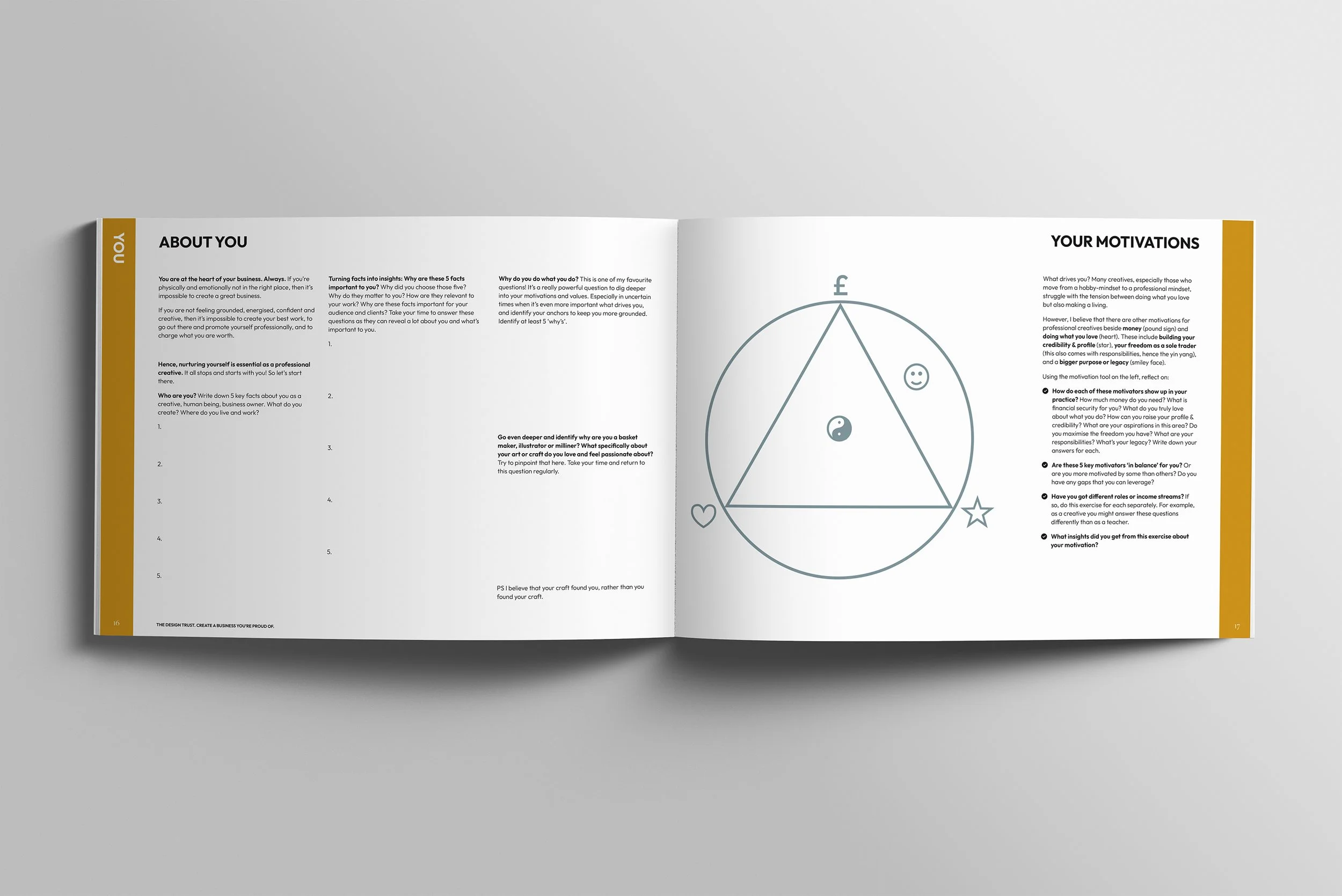
The 5 Motivations of Creatives exercise in our Dream Plan Do planner handbook 2026
A quick Creative Business Model Audit
If you haven't stood back and looked at your business like this for a while, start here. Don't try to answer these questions in five minutes. Get your figures out, look at what has actually happened over the last year or two and give yourself some proper thinking time.
1. Look at your money
Where does your turnover actually come from? Where are the sales? From your own website, commissions, teaching? And go even deeper than that: which commissions or galleries or craft fairs are bringing in money?
Which income streams look successful (because they generate significant sales) but become much less attractive once you include all the costs and your time? Are they really profitable?
Which income is relatively predictable and which is sporadic?
Where have you seen growth or decline over the last two or three years? Do you know why?
2. Look at your market
Who are your best customers? How did they get to know you?
Which events, galleries, platforms and marketing channels still work well for you?
Where are you seeing changes?
Which customers do you want more of? Which do you want to say ‘good bye’ to?
Are there opportunities emerging? Perhaps commissions, teaching, collaborations, higher-end work or organisational clients, that you haven't taken seriously enough yet?
3. Look at yourself
Which parts of your business do you genuinely want to do more of? What are you increasingly reluctant to do?
What has changed in your life, your available time, your energy or your responsibilities in the last 3 years?
How has your creative practice developed?
Have your values changed?
What are you curious about now that wasn't even on your radar five years ago?
4. Look ahead
What would you like your creative business to look like three to five years from now?
Which parts of your existing business model are helping you get there? Which income streams or sales channels are currently delivering that?
Which parts might actually be keeping you attached to an earlier version of your business?
What could you strengthen?
What could you simplify?
What might you stop?
And what might deserve more of your time, money and attention?
Questioning your business model isn't failure
It can be unsettling to ask these questions, particularly when something that used to work well isn't working anymore.
But please don't automatically turn that into a judgement about yourself.
The economy changes. Markets change. Technology changes. Customers change. Our personal circumstances change. Our creative ambitions change.
The responsibility we have as business owners isn't to predict all of that perfectly. It is to notice, learn and respond.
And there is something enormously powerful about moving from Why isn't this working anymore? to What do I want to create instead?
You might decide that wholesale absolutely deserves to remain at the heart of your business.
You might decide to do fewer but better events.
You might discover that teaching, commissions or collaborations deserve considerably more attention.
You might realise that the answer isn't another income stream at all, but better pricing, stronger positioning and more focus on the work you already do exceptionally well.
There isn't one new business model that every creative should be moving towards, and I would be very suspicious of anybody who tells you there is.
The important thing is that your business model is created deliberate.
Understand your numbers. Notice what is changing. Be clear about your values and ambitions. Explore your options. And then make conscious decisions about what deserves to stay, what needs to change, what you want to grow - and what you are ready to let go.
Because ultimately, a resilient creative business isn't built by continually adding more. It is built by getting clearer about what matters, what works and what you want your business to make possible next.
Sounds good, this is how we can help you …
Our Dream Plan Do programme is for you! With our special designer planner handbook and the annual Festival in January we will help you make time to reflect, to plan, to make decisions and to turn big ideas into more do-able plans. Note that you can only join our Dream Plan Do programme for a few days each September, and then in November - December, as Dream Plan Do runs from January - December.
We regularly have training around more sustainable income streams like commissions & teaching - check out what is on offer right now!
And if you are a successful creative then do check out how Patricia can work with you one-to-one as well.
Did you find this article thought-provoking? Did you get any insights? Then do share with us below in the comments.
